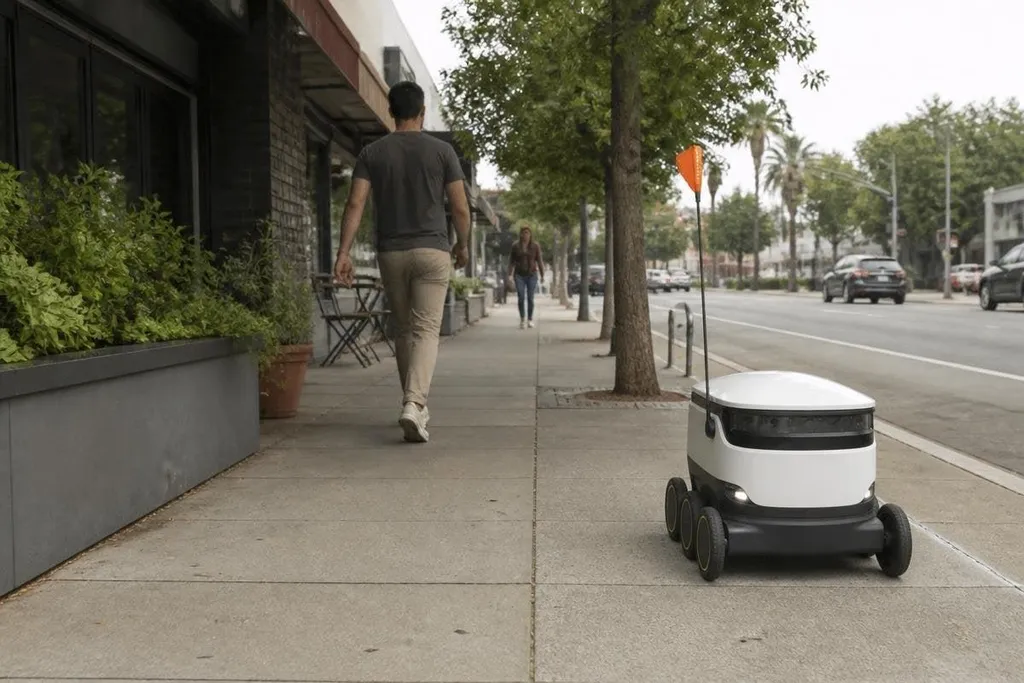
Short videos can make sidewalk robots look ready for daily public use, even when the evidence remains thin. The useful question is which advances improve delivery, safety, or service outside a controlled test area.
- A demo does not prove reliable sidewalk work.
- The useful numbers include speed, runtime, payload, and remote-operator hours.
- Public deployment needs evidence from named places, dates, and machines.
Start with the job
Sidewalk robotics covers several different jobs. A delivery robot carrying food has different needs from a machine that maps paving damage or moves supplies across a campus.
That difference matters because a faster robot may help one task and create problems in another. A delivery unit needs space for cargo, safe stops, and a way to handle blocked paths. A mapping robot needs consistent sensor data and enough battery time to finish its route.
A claimed advance should name the job first. Then it should show what changed for that job, using figures that someone else can check.
What counts as progress
The strongest evidence follows the robot beyond a staged demonstration. A useful report names the machine, the operator, the location, the date, and the task completed. It also explains how many trips or work hours the result covers.
Numbers should stay close to the claim. If a company says its robot can carry a useful load, the report should state the payload in kg and the route conditions. If it says the robot can work for a full shift, the evidence should give battery runtime in hours, charging time, and the number of stops.
Avoiding people in an empty test area shows one narrow result. A public trial needs details about crossings, blocked paths, remote supervision, emergency stops, and events that forced a human to take control.
A blocked path exposes more than route planning: it shows how the robot, operator, and city respond when the planned trip stops working. Sidewalk robotics reporting from Robot24.com can tie that event to the trial date, machine, and control rule. That record gives the next section a clear starting point: which limits still matter in daily use.
The limits that matter most
Sidewalks change from one route to the next. Curbs, ramps, parked bikes, road crossings, weather, crowds, and surface damage can all change the work a robot must do. A report that leaves out those conditions gives you little help when your route looks different.
Remote control is another point to check. Most of a trip may run without a person, yet the system may still need help when it meets an unusual obstacle. That does not make the system useless, but it changes staffing, cost, and the number of robots one operator can support.
Cost also needs a full view. The purchase price is only one part of the decision.
You need the robot price, charging equipment, support labor, insurance, repairs, and the fee for any remote-control service. If those figures are missing, the business case is unfinished.
I’d reject any list of the biggest breakthroughs that ranks videos above measured public work.
A buyer’s evidence check
Use this check before treating a sidewalk robotics claim as ready for your site:
- Name the machine: record the exact model and the company responsible for it.
- Check the setting: note the route, surface, weather, traffic, and pedestrian conditions.
- Read the numbers: look for speed, payload, battery runtime, charging time, and route length.
- Count human help: ask how often a remote operator stepped in and how long each intervention took.
- Price the full job: include hardware, staff time, repairs, insurance, and site preparation.
- Find the limit: write down the task, route, or condition the evidence does not cover.
That last point often decides the purchase. The machine may work well on a fixed campus route and still need more testing before a city delivery service can rely on it.
The next useful milestone is not another short demo. It is a dated public trial that reports route length, work hours, human interventions, operating cost, and failed runs, so a buyer can compare the result with their own pavement.